Ambition is often painted as a virtue — a drive to improve your life, to create, to push forward. But in a narcissistic family system, your ambition isn’t celebrated. It’s twisted. Manipulated. Used against you.
For scapegoated sons, this is especially brutal. You’re told to “make something of yourself.” When you start to, the same people who gave you that message become distant. They become cold, even mocking. They say you’ve changed. That you think you’re better. That you’re being selfish.
They’ll praise others for doing far less — while minimizing your efforts, ignoring your achievements, or outright sabotaging them. If you chase something meaningful, they’ll tell you it’s a phase. If you succeed, they’ll act like it was never a big deal. If you fail, they’ll act vindicated.
The goalposts are always moving.
What makes it worse is the mental conflict it creates. You start to internalize their voice: “Maybe I am selfish. Maybe I’m being unrealistic. Maybe I do think I’m better than everyone.” This guilt is manufactured. And it’s designed to do one thing — keep you small.
Importantly, ambition isn’t always about money, power, or material success. It can be about your personal growth. This involves learning new hobbies, exploring the world, or simply wanting a peaceful, self-directed life. In a narcissistic family, even that is threatening. Wanting a new experience or to try something for yourself will be painted as “abandonment,” “selfishness,” or “delusions of grandeur.”
Your ambition is threatening. It is not because you’re doing something wrong. It is because it exposes what they refuse to face in themselves. Your growth reminds them of their own stagnation. Your wish to leave this structure puts their control at risk.
So they weaponize your ambition. Not always through loud attacks — often through subtle jabs, passive-aggressive comments, or emotional withdrawal. It’s all designed to make you question your worth just enough to keep you coming back for their approval.
But here’s the truth: your ambition doesn’t need their permission.
What you’re building doesn’t have to make sense to others. It could be a new mindset, a career, or a new life. These people never saw you clearly to start with. You don’t owe anyone the performance of staying small.
In today’s world, masculinity is often ridiculed. If you express masculine traits—like directness, decisiveness, or even healthy assertiveness—there’s often an effort to infantilize you. Toxic individuals may try to “knock you down a peg,” using passive-aggressive tactics or condescension to undermine your confidence. This is not about who you are as a person but rather a reflection of their own inadequacies.
On the other hand, when you do something noble or altruistic, there’s often a patronizing element aimed at emasculating you. For example, if you carry out an act of kindness or generosity, it might be met with backhanded compliments. These remarks subtly put you down and label you as “soft” or “a sissy.” This is illogical and rooted in control—they seek to diminish your self-worth by twisting positive actions into something negative.
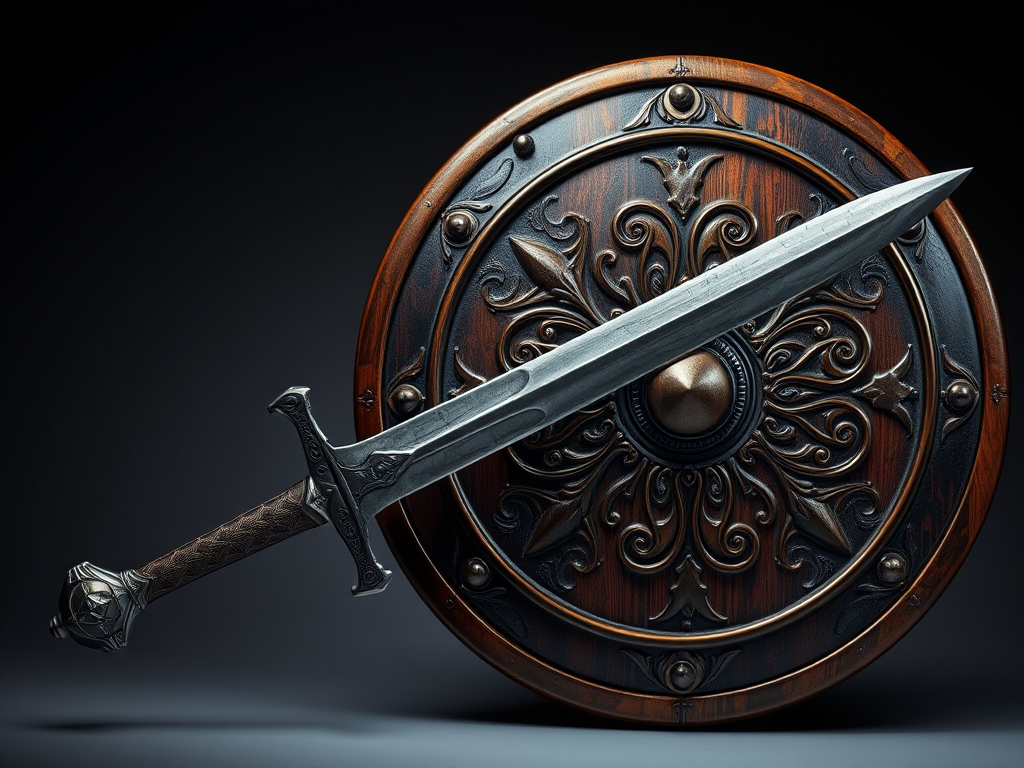
The Shield: Emotional Control
The shield shows emotional control—the ability to let their words fly over your head without engaging in their game. They thrive on reactions; denying them that satisfaction takes away their power.
Instead of reacting emotionally, let them talk. Toxic individuals often reveal their true selves over time. Their façade of superiority begins to crack, exposing them as wounded individuals projecting their own hurt onto others. Keep your composure. Refuse to stoop to their level. Doing so helps you protect your boundaries. You also preserve your dignity this way.
The Sword: Physical Confidence
While the shield shows emotional control, there are moments when using your sword becomes necessary. The sword symbolizes the cultivation of power to protect yourself.
For example, if someone raises their voice, this is where the sword comes into play. If they invade your personal space or try to physically push you around, it also applies. Decisiveness in these moments involves using strong body language to set boundaries. Standing tall, maintaining eye contact, and speaking firmly can often diffuse these situations before they escalate further. If physical defense becomes necessary, being fit and strong gives you the confidence to protect yourself effectively.
A key aspect of wielding the sword is working on your body image. Regular exercise, like going to the gym, not only improves physical strength but also elevates your confidence and competence. Feeling strong in your own body translates into feeling strong in your interactions with others.
To take this even further, learning a martial art can be transformative. Martial arts not only teach self-defense but also instill discipline, focus, and mental resilience. Knowing that you have the skills to ward off potential threats significantly boosts your confidence. It also allows you to navigate life with a sense of security.
Conclusion: Standing Firm in Your Identity
The key is recognizing that these attempts to ridicule masculinity—whether through infantilization or patronization—are not about you but about them. Stand firm in your identity and values. Use both the shield (emotional control) and the sword (decisiveness). This approach enables you to navigate these situations with strength and grace.
This topic has been simmering in my mind for a long time, and I’ve been planning to write about it. Some aspects were tough to wrap my head around, not because they’re complicated – they’re pretty straightforward, actually. Instead, it’s because it’s not necessarily a black-and-white area. This is especially true if you’re a male who grew up in a toxic, narcissistic family.
‘Help’ is a word that can feel like the opposite of what it should be. I used to falsely interpret it as help no matter the cost, even if it led to negative consequences. It included help even if I didn’t ask for it, or knew deep down it wasn’t in my best interest. Man, was I wrong about that! Or maybe, subconsciously, I was right because all along, the help I was made to take on wasn’t suitable. Narcissist parents use this tactic a lot to manipulate and control. It works well with small children who haven’t yet formed their preferences and developed their identity.
Yet, as a person grows, particularly a male, they start to feel threatened by their masculine development. From my personal experience, I’d be accused of taking my independence too far or not listening enough. What an odd thing to say to a young male growing into an adult! This should be encouraged, not stifled.
This could also explain a scapegoat’s initial aversion for help.Starting from the beginning as a scapegoat, you may have had a distant father and an overbearing, needy mother. This isn’t always the case. Still, from my experiences and conversations with others, I’ve noticed a pattern.
Writers like Devin Stone often describe the overt, active, grandiose narcissist as usually the father. The quieter, passive-aggressive narcissist is usually the mother.This ties into our complicated relationship with help as male scapegoats. On one hand, you’d want to seek help, especially as a kid. But since narcissists don’t really care about anyone but themselves, the help doesn’t feel genuine. So, you’d go to your father for help. He couldn’t be bothered. Worse, he’d easily show annoyance and irritation, giving a vibe of being pissed off. This is him demonstrating that you’re a nuisance, leading you to see yourself as a burden.In the past, you might’ve gotten the kind of help that was always set to undermine you. A needy, narcissistic mother would be condescending, offering help like you’re a five-year-old. Also, insisting on being overly involved and feigning concern unnecessarily is a tool to keep you dependent and second-guessing yourself.For some of us, this can lead to learned helplessness – thinking we can’t take action and make decisions ourselves. This is bullshit!
Sometimes we decide we don’t want to deal with unreliable or insecure people trying to bring us down. So, we take a different, harder path where we become ultra-independent. This becomes a positive trait for men as we can transfer this energy into other parts of our lives. But how do you reverse that?I believe you should refuse help from untrustworthy people and those who derive pleasure from creating petty power plays.
Keep in mind narcissists will use snippets of the truth to manipulate the situation. For instance, my mother would also say, ‘You don’t like asking for help.’ Well, it’s no surprise if someone is averse to this if they sense an ulterior motive. Narcissists use ‘help’ as a guise to control most of the time. They place themselves in a superior position while failing to actually help. So how do you find trustworthy sources of help? Start by looking at their life and character. Are they generally supportive and reliable? Do they respect your boundaries and autonomy? Consider those aspects of who they are. If they sit well with you, then proceed. Always remain an active participant when receiving help. Ultimately, it’s your life. Also remember to challenge those harmful beliefs that prevent you from seeking support.
It’s beneficial to bounce ideas off other people. Getting help along the way is important in our careers, daily tasks, or social interactions. Consider seeking professional support, like therapy, to process your experiences. Develop healthier coping mechanisms with assistance from a male who can recognize such patterns. I also think the journey of healing from being the scapegoat can’t be done alone. It can, but it’ll take years and be a much more difficult experience. Realizing patterns earlier in life by going to others for help has been key for me. That’s why I stress the importance of confiding in and interacting with safe and loyal people on this journey.
I hope you all had an enjoyable and well-rested Christmas Day. For those who do not celebrate it, I hope yesterday was a great day for you as well. I have earlier touched upon the holiday period and provided updates on my eBook. The time from the day after Christmas to New Year’s Eve is usually for planning. It’s also a period for resting and reflection.
I now want to dig deeper to discuss important topics related to the blog. Some of you can relate to this, but others might not be completely familiar with it. In my first post, I talked about the meaning of Scapegoating. I will mainly focus on the male experience. Now, I will give my thoughts and opinions on how this is determined.
A male can be scapegoated in different ways in a narcissistic family and for many reasons. Through my personal observations and experiences, I have noticed various nuances. It is not a black and white scenario. Different patterns and stages in life can alter how this role can be assigned.
Narcissistic Family Roles: Golden Child, Scapegoat, and More
As I will touch upon in future content, narcissistic family members, especially parents, assign different roles to their children. The main types are the:
Golden Child: Seen as reflective of all the good qualities of the family and who does no wrong.
Scapegoat: Blamed for all the family problems and seen as a difficult person.
Lost Child: Not much attention is paid towards them.
Yet, there are also extra roles like the mascot. This extra role would be a child who tries to instill humor. It aims to convey fun. This serves as a distraction from the real problems. Initially, I always thought the roles were assigned due to birth order and even gender, which happens sometimes.
This is dependent on different variables, including the response the parents receive at the time or how they’re feeling. I always thought it would typically be the oldest who is scapegoated. This happens because the eldest child may notice the early signs of dysfunction. They are the first to spend time with their parents. Whatever a narcissistic family feels is a threat to them is immediately thwarted. This could take the form of a combination of emotional manipulation and physical abuse to keep the eldest in line.
Another way that males can be scapegoated is by attacking a son’s character. If there are multiple sons in a family, for example, one may decide to show masculine characteristics like assertiveness. This can include independent thought and healthy disagreement. When this happens, they are demonized. They are made out to be a problem child. They are seen as going against family values.
The roles also switch. That particular son may be the golden child when they are much younger. This is particularly true if they’re seen as quiet and gentle.
Case Study: The Eldest Son’s Experience
In many narcissistic families, the eldest son often finds himself in the scapegoat role early on. Consider the story of “Josh.” He is a 38-year-old man who grew up in a family with a highly narcissistic father. As the eldest child, Josh initially showed more assertive behavior earlier on in comparison to his younger siblings.
Initial Criticism: Josh was seen as the “Scapegoat” during his early years. His father would use excessive physical punishment for small mistakes. He punished Josh if he voiced an opinion the father did not like. He would undermine his self-esteem by stating he was “stubborn and ungrateful.”
Shift to Golden Child: As Josh matured, he stopped challenging his father’s controlling behavior. This would lead him to internalize everything his father thought and to take on his father’s mentality. Josh received excessive praise from his father. He did whatever it took to gain his approval. This was often not the best decision for Josh.
Long-Term Effects: Josh experienced early scapegoating, which transitioned him into the golden child role. As he got older, he struggled with feelings of inadequacy. He also faced issues with his sense of self. He realized he had to prove his worth. He adopted traits learned from his father, which led to more narcissistic and dysfunctional behavior.
Josh’s story illustrates how a scapegoat can transition to a golden child. His younger brother, Phil, demonstrates the opposite trajectory through his experience.
Case Study: The Shift from Golden Child to Scapegoat
Now let’s look at another situation where scapegoating happens much later. Sometimes the younger son would be seen as the golden child for appearing gentle, well-behaved, and obedient. Let’s consider the story of Josh’s younger brother Phil, aged 31 years old, who grew up in the same household. As a child, he was known to be quiet, sweet, and likable.
Initial Praise: Phil was seen as the “golden child” early on. He was praised for being easy-going. He did what pleased his parents.
Shift to Scapegoat: As Phil matured, his personality and preferences started to develop. This brought disapproval to his father who saw this as a threat. This led to his father’s anger and emotional manipulation where Phil was seen as the problem.
Long-Term Effects: This would cause Phil to second-guess himself and to think that he must be perfect to be accepted. This would also lead to constant guilt in adulthood.
Challenging Assumptions: Strength vs. Weakness in Scapegoating
It is always thought that narcissistic families target someone deemed as weak. A lot of the literature has stated this, but others have said this is not the case. I agree with the latter as I think it can be quite complicated.
On one hand, if a son is gentle, empathetic, and caring when they’re young, they’re seen positively. Those characteristics can be seen as feminine. This will be used against the son with those characteristics, but also the masculine mentioned earlier.
They thwart the latter through guilt but try to praise the feminine characters. They still see a son with these traits as a threat. These traits could lessen the feminine ones. They might strengthen the more masculine traits as the son gets older.
Conclusion: Inviting Reader Engagement
This is a very complex matter and something. It took me some time to figure out and still doing my learning on. I will be discussing more of this topic in future content.
I would like to hear from you. In your experience, what things do you feel decide how a male is assigned the scapegoat role? What are your own experiences if they resonate? Have you seen any other patterns that I have not mentioned or you feel could be discussed further?



 Son in the Shadows: "Navigating Life as the Black Sheep of Narcissistic Parents"