How Narcissistic Family Systems Use Roles — and Why the Male Scapegoat Breaks the Spell
Halloween is the one time of year the world celebrates masks. But for those raised in narcissistic families, masks are a daily reality — and they’re not for fun.
These family systems operate through illusion, performance, and control. Every member is assigned a role, and stepping outside that role threatens the whole façade.
Common roles include:
The Golden Child – the “perfect” projection
The Scapegoat – the truth-teller, blamed and punished
Flying Monkeys – enforcers of the illusion
The Narcissistic Parent(s) – the director of the performance
Everyone is wearing a mask… Except the scapegoat.
And that is precisely why he becomes the threat.
🎭 The Role You Refused to Play
Narcissistic families don’t want individuals. They want mirrors, obedience, and emotional labor.
The scapegoat isn’t rejected because he is flawed — He is rejected because he refuses to submit to a lie.
He won’t: ✅ perform for approval ✅ shrink himself for others’ comfort ✅ feed the fantasy ✅ abandon his identity ✅ be the emotional sacrifice forever
They don’t punish you for being weak. They punish you because you were strong enough not to be controlled.
👻 When You Take Off the Mask
Once you stop performing and begin to break free:
You set boundaries
You choose independence
You focus on your identity and purpose
You stop chasing people who don’t see your worth
You embrace self-respect over people-pleasing
The illusion collapses.
And when the mask slips, they panic. Not because you harmed them — but because you saw through them.
Your truth threatens their fiction.
🕯️ Light Always Terrifies Shadows
These families only hold power when everyone cooperates with the illusion.
When you step away from the role, you expose the truth:
They were never what they pretended to be.
Your healing is their loss of control. Your boundaries are their defeat. Your freedom is the only closure you ever needed.
You didn’t lose a family. You escaped a performance.
🎬 Closing
This Halloween, remember:
Some monsters don’t wear costumes. They wear masks.
And your greatest act of rebellion was taking yours off first.
📌 Part 2 Coming Next Friday
Stay tuned for the continuation — and watch my related video on YouTube @SonintheShadows.
Ambition is often painted as a virtue — a drive to improve your life, to create, to push forward. But in a narcissistic family system, your ambition isn’t celebrated. It’s twisted. Manipulated. Used against you.
For scapegoated sons, this is especially brutal. You’re told to “make something of yourself.” When you start to, the same people who gave you that message become distant. They become cold, even mocking. They say you’ve changed. That you think you’re better. That you’re being selfish.
They’ll praise others for doing far less — while minimizing your efforts, ignoring your achievements, or outright sabotaging them. If you chase something meaningful, they’ll tell you it’s a phase. If you succeed, they’ll act like it was never a big deal. If you fail, they’ll act vindicated.
The goalposts are always moving.
What makes it worse is the mental conflict it creates. You start to internalize their voice: “Maybe I am selfish. Maybe I’m being unrealistic. Maybe I do think I’m better than everyone.” This guilt is manufactured. And it’s designed to do one thing — keep you small.
Importantly, ambition isn’t always about money, power, or material success. It can be about your personal growth. This involves learning new hobbies, exploring the world, or simply wanting a peaceful, self-directed life. In a narcissistic family, even that is threatening. Wanting a new experience or to try something for yourself will be painted as “abandonment,” “selfishness,” or “delusions of grandeur.”
Your ambition is threatening. It is not because you’re doing something wrong. It is because it exposes what they refuse to face in themselves. Your growth reminds them of their own stagnation. Your wish to leave this structure puts their control at risk.
So they weaponize your ambition. Not always through loud attacks — often through subtle jabs, passive-aggressive comments, or emotional withdrawal. It’s all designed to make you question your worth just enough to keep you coming back for their approval.
But here’s the truth: your ambition doesn’t need their permission.
What you’re building doesn’t have to make sense to others. It could be a new mindset, a career, or a new life. These people never saw you clearly to start with. You don’t owe anyone the performance of staying small.
Nearly three months ago, I wrote a blog post dedicated to the month of January. It focused on its challenges and the opportunity to develop strength and resilience to overcome them. January often sets the tone for the year. Yet, April offers a unique opportunity for a fresh start. It provides a second chance to build on what we began. It can also be a chance to start completely new.
This is not just for the start of January but can be applied to the beginning of any time period. Yet, I thought this would be quite fitting for April as this was the original New Year. Still till this day various cultures like many South East-Asian cultures celebrate this month as the new year. Also other places like the United Kingdom have April as the start of the new tax year.
It is also the start of spring. It marks a time of new beginnings. There are changes for the rest of the year. Forget to take up that hobby in January? It is not too late, now you can start it. Procrastinated on starting a project that you meant to in January? You can still pursue this right now in April. Or, if you couldn’t start going to the gym? No problem this can still be worked on this month and beyond.
By doing the things that didn’t work out or perhaps taking longer than expected, you develop resilience. You achieve this by continuing the task during periods of stress. Continue even when it isn’t going the way you want. You can apply this to recovering from your role as a black sheep, as you may hit roadblocks and curves. Just as long as you’re capable of staying on course you can overcome this. If you’re a man who feels like a black sheep, you may be too hard on yourself. You might experience setbacks not just in healing but also in professional, educational, and financial situations.
Resilience, in this context, is about reclaiming your narrative. It’s about refusing to let past labels define your future. It’s about building a foundation of self-worth that can withstand the inevitable setbacks. Resilience isn’t just about pushing through; it’s about adapting, learning from setbacks, and cultivating a positive mindset. It’s about recognizing that growth often comes from overcoming challenges. Even when things don’t go as planned, there’s always an opportunity to learn and evolve.
For men who have been labeled the black sheep, resilience is not only a tool for healing. It is also a way to build a new identity and reject the old labels. It is not always easy. To be able to move forward, and to heal from past wounds. However, small steps are still progress, and will eventually lead to a better future.
April is a reminder that we have the power to create new beginnings and cultivate resilience. Let’s embrace this opportunity to grow, heal, and thrive.
What are your goals for renewal this April? Share your tips for building resilience in the comments below!
In today’s world, masculinity is often ridiculed. If you express masculine traits—like directness, decisiveness, or even healthy assertiveness—there’s often an effort to infantilize you. Toxic individuals may try to “knock you down a peg,” using passive-aggressive tactics or condescension to undermine your confidence. This is not about who you are as a person but rather a reflection of their own inadequacies.
On the other hand, when you do something noble or altruistic, there’s often a patronizing element aimed at emasculating you. For example, if you carry out an act of kindness or generosity, it might be met with backhanded compliments. These remarks subtly put you down and label you as “soft” or “a sissy.” This is illogical and rooted in control—they seek to diminish your self-worth by twisting positive actions into something negative.
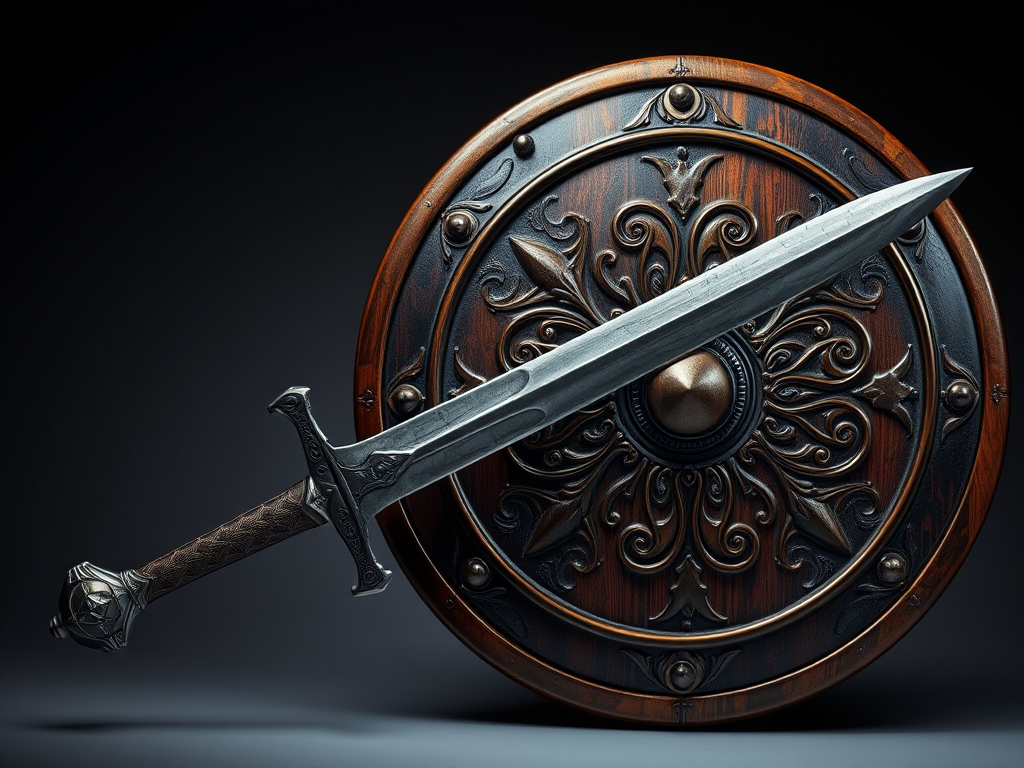
The Shield: Emotional Control
The shield shows emotional control—the ability to let their words fly over your head without engaging in their game. They thrive on reactions; denying them that satisfaction takes away their power.
Instead of reacting emotionally, let them talk. Toxic individuals often reveal their true selves over time. Their façade of superiority begins to crack, exposing them as wounded individuals projecting their own hurt onto others. Keep your composure. Refuse to stoop to their level. Doing so helps you protect your boundaries. You also preserve your dignity this way.
The Sword: Physical Confidence
While the shield shows emotional control, there are moments when using your sword becomes necessary. The sword symbolizes the cultivation of power to protect yourself.
For example, if someone raises their voice, this is where the sword comes into play. If they invade your personal space or try to physically push you around, it also applies. Decisiveness in these moments involves using strong body language to set boundaries. Standing tall, maintaining eye contact, and speaking firmly can often diffuse these situations before they escalate further. If physical defense becomes necessary, being fit and strong gives you the confidence to protect yourself effectively.
A key aspect of wielding the sword is working on your body image. Regular exercise, like going to the gym, not only improves physical strength but also elevates your confidence and competence. Feeling strong in your own body translates into feeling strong in your interactions with others.
To take this even further, learning a martial art can be transformative. Martial arts not only teach self-defense but also instill discipline, focus, and mental resilience. Knowing that you have the skills to ward off potential threats significantly boosts your confidence. It also allows you to navigate life with a sense of security.
Conclusion: Standing Firm in Your Identity
The key is recognizing that these attempts to ridicule masculinity—whether through infantilization or patronization—are not about you but about them. Stand firm in your identity and values. Use both the shield (emotional control) and the sword (decisiveness). This approach enables you to navigate these situations with strength and grace.
Many years ago, I always assumed that time was endless. Recently, I have come to the conclusion that time is one of the biggest and most important commodities. As the old saying goes, “If you waste money, you can always earn it back. But if you waste time, then that is something you never regain.”
In the context of my acronym, it means that you’re the architect of your own life. You should not let anyone dictate or control when or how you spend it. You should be capable of saying ‘no’ to what doesn’t serve you. Say ‘yes’ to things that will help you.
I realized that it’s importantto choose who I spend my time with carefully. It’s also crucial to consider how much time people can take. In my own journey of recognizing toxic family and people , I learned the importance of preserving time. Think of time as a currency. If someone, takes this away they’re effectively stealing a possession of yours. This helped me to have more respect and take care of my time.
When dealing with a family of narcissistic individuals, this is even more important. Initially, you do not realize that they are taking your time for granted. In this context, there is another meaning of ‘time’. Here it is:
T- Take Back Control– This means setting boundaries and learning to arrange self-care. This can include taking up a hobby that you have always wanted to do. It could also mean saying ‘no’ to going to a particular place. You may no longer feel that you are part of or comfortable with this place.
I-Identify Patterns– It could be that you start to recognize behaviors that are holding you back and are an obstacle. This will also involve identifying the way narcissists can manipulate time and you can break free from these patterns. It involves a high degree of self-awareness.
M-Managing your Time– You should learn to schedule time for work and leisure. To avoid having to feel a guilty obligation to do something you don’t want to. Another, way is to make the most of time by creating goodexperiences, and putting yourself out there.
E- Empower Yourself– Its all about celebrating small wins, remembering good memories and events having hope for the future.
Speaking of Time…
As we explore the importance of managing time effectively, I’d like to share a deeper dive into my journey and future plans. Check out my latest YouTube video. This is where I discuss what’s next for the channel and the topics we’ll be covering moving forward.
In conclusion, taking control of your time is crucial for personal growth. It is especially important when healing and dealing with narcissistic family dynamics. By applying the T.I.M.E. principles, you can empower yourself to make positive changes in your life.
I reflected on my last post on perfectionism. I thought about a few other related topics. I had considered these within the last few years or so. Nevertheless, this thought became more vivid as I was in the middle of my workout this morning. This is a perfect segue to my next discussion.
Also, the path to success and to fulfill your potential ultimately comes from failure and setbacks. It will involve at times taking a step back, evaluating things, and doing something unconventional. I read a quote somewhere. It said, “You are not scared of the actual failure. The fear is about what people will think.” I think this hit home for me, as a man we want to be seen as competent and strong.
A tiny error or mishap could ruin this. It also goes to my experience that if a setback occurs, toxic family members start to become patronizing and unsupportive. I have now learned to ignore this, as you can’t control people’s reactions. At the end of the day, it says more about them than you. Many people are scared and feel ashamed of others’ opinions. They avoid doing what you try and project that fear onto you when you take on a new challenge.
The second fear is being seen as ‘bad’. I think this term is broad. In society now, a lot of censorship targets male behavior. This is obvious with movements like feminism and #MeToo. Coupled with messages that boys get in schools about being seen as bad.
As a male scapegoat, you are judged harshly. This intensifies as you’re given all sorts of labels. Examples include ‘difficult’ and ‘rebellious’. I believe that human nature has many layers. One can’t be perfect all the time. You are not hurting others. It is okay to have different preferences and not feel that it makes you bad. This could be a particular hobby or personal style.
I would love to hear what mistakes you were afraid to make. Were you perceived as bad? If so, how? This topic will be explored in more detail in my upcoming ebook, “Unshackled: A Man’s Journey from Family Scapegoat to Self-Empowerment”.
Hey all! I hope everyone is persevering through January since it is a very long month. As the first month of a new year feels long, this is a good opportunity for us. We can work on our goals and prepare for a good start. Towards the end of last year, I mentioned that I would start posting regularly in the new year. I committed to that.
Unfortunately, this has not happened. I have been juggling multiple projects. Also, I am preparing for the release of “Unshackled: A Man’s Journey from Family Scapegoat to Self-Empowerment”. It is still on pre-sale. A release date will be confirmed soon.
I realize that during a busy period, one can feel overwhelmed and want to be sure everything is right. This includes wanting every single blog post to be perfect and flawless. This explains why it has been two weeks since my last post. I realized that this has resulted in sinking into feelings of perfectionism. It is not to say being diligent and wanting to be precise is a negative trait at all. But, leaning at the extreme end could reverse those positive traits.
For us men, who have been scapegoated in the past, making a single mistake can ruin our momentum. Even a slight mishap in our plans or tasks can have this effect. I have learned that mistakes or situations not going perfectly are a part of life.
This can be easier said than done especially for us, male scapegoats. If we make a mistake or if something in our lives goes wrong our ego takes a huge hit. From my experience, it is mainly due to fear of criticism from experiencing this constantly while growing up. As a result, it would lead to difficulties with self-acceptance and self-worth.
Imperfections are something to embrace because if you gradually improve you can look at how far you have come. Also, imperfections make you more relatable and real. This is something that was not allowed in a toxic environment with a lot of censorship. Ultimately, perfectionism will lead to procrastination.
During the quiet month of January, it has given me time to think about what is important. I keep in mind that gradual progress is still progress, no matter how small. Even the odd bad day is not a death sentence. It is a chance to be accountable and move ahead.
There are different ways that perfectionism can be combat. Firstly larger tasks can be broken down into small manageable steps. Also celebrate small wins. This is something that happened to me this past Sunday. I didn’t feel like going to the gym but I still went anyway. I didn’t do everything I intended but hit a PR on the deadlift. So, I would like you to think about what you achieved during the week. It can be anything.
As I continue to work on the eBook and other tasks, I am learning. Progress is not about perfection. It is about consistent effort. I look forward to sharing more of my journey with you in the coming weeks.
Back with another post to go into more depth with male scapegoating. I touched upon factors and motives that would influence how a male scapegoat is selected. Now I will first define male scapegoating in the family context. It involves systematically targeting and blaming a male family member, typically a son. This is done for the problems and failures or negative emotions within the family.
This involves unfair criticism and blame directed at the male individual. Families like this are very toxic. They are harmful for male scapegoats because there is a lot of emotional manipulation. Psychological abuse is also prevalent. They do this by undermining the individual’s sense of self-worth and masculinity. As a result, the family uses the designated male as a repository for family tensions and dysfunction.
Male scapegoating can be particularly damaging due to societal expectations of male strength and resilience. This makes it harder for the target to seek help or acknowledge the abuse. The definition above emphasizes the unique challenges faced by male scapegoats in narcissistic family systems.
If left unrecognized, growing up in such an environment has significant long-term psychological implications for the male scapegoat. It harms the male’s self-esteem and leaves them with feelings of unwarranted guilt. It also leads them to not trust people easily or to show their true selves in relationships. Scapegoating can affect other areas of life, including school and the workplace. The target becomes conditioned to tolerate bullies, toxic bosses, and deceptive colleagues. The male scapegoats would then feel there is something wrong with them and that they’re defective.
This leads to feeling misunderstood, which brings me to my next point, societal factors. I believe this is one of the strongest implications that male scapegoats face. In the current climate, a lot of males are struggling with their identity and place in the world.
A male scapegoat is even more confused. They’re attacked by their family for showing their true masculinity. They also face challenges in the current climate, which holds a negative view on masculinity. A lot of males are not encouraged to be themselves and are encouraged to be more feminine. These traits are not necessarily bad. We all have a mix of these from both genders. Nevertheless, there can be an unhealthy balance. Other factors come into play with this including more single mother households. Even in families with two parents, toxic behavior can lead to similar problems for men.
On the bright side, there are ways that a male scapegoat can combat this and different strategies. A lot of this I relate to. The most important way to overcome the effects of being scapegoated is via self-development. This is good because it would focus on all areas of a man’s life. It includes developing their mental framework. It also involves changing their outlook, pursuing different passions, and learning new skills. What also helped me is through sharing any problems with trusted close friends.
A male uses various coping strategies discussed above. He learns to be their own person by forging their identity. A right that was denied growing up. From early in their life, a male scapegoat develops a mentality aimed at breaking the cycle of intergenerational trauma. They become the total opposite of their family of origin. I remember once. I made a drastic change in my life. When a close friend saw this, they stated that I was always so different from my family.
I would like to know more about your understanding of male scapegoating and your definition of it. It will be helpful to know how unique everyone else’s experiences have been. Perhaps you may have a friend who has gone through a similar experience? Feel free to share what you know. I will want to go deep into this topic in the future.
I hope you all had an enjoyable and well-rested Christmas Day. For those who do not celebrate it, I hope yesterday was a great day for you as well. I have earlier touched upon the holiday period and provided updates on my eBook. The time from the day after Christmas to New Year’s Eve is usually for planning. It’s also a period for resting and reflection.
I now want to dig deeper to discuss important topics related to the blog. Some of you can relate to this, but others might not be completely familiar with it. In my first post, I talked about the meaning of Scapegoating. I will mainly focus on the male experience. Now, I will give my thoughts and opinions on how this is determined.
A male can be scapegoated in different ways in a narcissistic family and for many reasons. Through my personal observations and experiences, I have noticed various nuances. It is not a black and white scenario. Different patterns and stages in life can alter how this role can be assigned.
Narcissistic Family Roles: Golden Child, Scapegoat, and More
As I will touch upon in future content, narcissistic family members, especially parents, assign different roles to their children. The main types are the:
Golden Child: Seen as reflective of all the good qualities of the family and who does no wrong.
Scapegoat: Blamed for all the family problems and seen as a difficult person.
Lost Child: Not much attention is paid towards them.
Yet, there are also extra roles like the mascot. This extra role would be a child who tries to instill humor. It aims to convey fun. This serves as a distraction from the real problems. Initially, I always thought the roles were assigned due to birth order and even gender, which happens sometimes.
This is dependent on different variables, including the response the parents receive at the time or how they’re feeling. I always thought it would typically be the oldest who is scapegoated. This happens because the eldest child may notice the early signs of dysfunction. They are the first to spend time with their parents. Whatever a narcissistic family feels is a threat to them is immediately thwarted. This could take the form of a combination of emotional manipulation and physical abuse to keep the eldest in line.
Another way that males can be scapegoated is by attacking a son’s character. If there are multiple sons in a family, for example, one may decide to show masculine characteristics like assertiveness. This can include independent thought and healthy disagreement. When this happens, they are demonized. They are made out to be a problem child. They are seen as going against family values.
The roles also switch. That particular son may be the golden child when they are much younger. This is particularly true if they’re seen as quiet and gentle.
Case Study: The Eldest Son’s Experience
In many narcissistic families, the eldest son often finds himself in the scapegoat role early on. Consider the story of “Josh.” He is a 38-year-old man who grew up in a family with a highly narcissistic father. As the eldest child, Josh initially showed more assertive behavior earlier on in comparison to his younger siblings.
Initial Criticism: Josh was seen as the “Scapegoat” during his early years. His father would use excessive physical punishment for small mistakes. He punished Josh if he voiced an opinion the father did not like. He would undermine his self-esteem by stating he was “stubborn and ungrateful.”
Shift to Golden Child: As Josh matured, he stopped challenging his father’s controlling behavior. This would lead him to internalize everything his father thought and to take on his father’s mentality. Josh received excessive praise from his father. He did whatever it took to gain his approval. This was often not the best decision for Josh.
Long-Term Effects: Josh experienced early scapegoating, which transitioned him into the golden child role. As he got older, he struggled with feelings of inadequacy. He also faced issues with his sense of self. He realized he had to prove his worth. He adopted traits learned from his father, which led to more narcissistic and dysfunctional behavior.
Josh’s story illustrates how a scapegoat can transition to a golden child. His younger brother, Phil, demonstrates the opposite trajectory through his experience.
Case Study: The Shift from Golden Child to Scapegoat
Now let’s look at another situation where scapegoating happens much later. Sometimes the younger son would be seen as the golden child for appearing gentle, well-behaved, and obedient. Let’s consider the story of Josh’s younger brother Phil, aged 31 years old, who grew up in the same household. As a child, he was known to be quiet, sweet, and likable.
Initial Praise: Phil was seen as the “golden child” early on. He was praised for being easy-going. He did what pleased his parents.
Shift to Scapegoat: As Phil matured, his personality and preferences started to develop. This brought disapproval to his father who saw this as a threat. This led to his father’s anger and emotional manipulation where Phil was seen as the problem.
Long-Term Effects: This would cause Phil to second-guess himself and to think that he must be perfect to be accepted. This would also lead to constant guilt in adulthood.
Challenging Assumptions: Strength vs. Weakness in Scapegoating
It is always thought that narcissistic families target someone deemed as weak. A lot of the literature has stated this, but others have said this is not the case. I agree with the latter as I think it can be quite complicated.
On one hand, if a son is gentle, empathetic, and caring when they’re young, they’re seen positively. Those characteristics can be seen as feminine. This will be used against the son with those characteristics, but also the masculine mentioned earlier.
They thwart the latter through guilt but try to praise the feminine characters. They still see a son with these traits as a threat. These traits could lessen the feminine ones. They might strengthen the more masculine traits as the son gets older.
Conclusion: Inviting Reader Engagement
This is a very complex matter and something. It took me some time to figure out and still doing my learning on. I will be discussing more of this topic in future content.
I would like to hear from you. In your experience, what things do you feel decide how a male is assigned the scapegoat role? What are your own experiences if they resonate? Have you seen any other patterns that I have not mentioned or you feel could be discussed further?
At around 11 a.m. on the 11th month of the year, the wait is finally over. A new journey begins with this primary post from me to you. I remember coming across a similar blog during this Autumn-to-Winter transition nearly a decade ago, but it disappeared quickly. Now, I feel compelled to create something similar. My intention is to keep it forever for myself and for all of you. I suppose the current season has inspired me to do this.
The time for celebration and events is approaching quickly. It dawned on me as Thanksgiving takes place next Thursday for my American counterparts. After that, Black Friday will occur next week, prompting a few thoughts to enter my mind. The holiday season – or festive season, depending on your country – is rapidly approaching. This time of year can evoke a range of emotions, from cheerfulness to feeling down and everything in between.
Nonetheless, for those who consider themselves the “Black Sheep,” this experience can be even more complex. It often brings up a multitude of thoughts and feelings.
Before diving deeper, let me briefly explain what being a “Black Sheep” means. It has various definitions. It is generally used to describe someone who is distinct from the rest. This is particularly true within a family system. In psychological contexts, this is called the “Black Sheep Effect.” An individual faces negative bias from their ingroup. They are judged more harshly compared to a similar outgroup member who is deemed deviant and threatens group identity.
For men, being a Black Sheep could manifest in several ways, including:
– Receiving inconsistent criticism about your masculinity from family members who feel threatened by it, or being ridiculed as a child for not meeting certain expectations (e.g., “boys don’t cry”).
– Being Scapegoated or taking the blame for family issues that aren’t your fault.
– Experiencing tension and conflict with family members without understanding the root cause.
– Struggling with self-esteem and identity issues due to receiving mixed signals and feedback.
– Feeling pressure to be perfect and meet expectations that are disconnected from your true self.
– Feeling out of sync with your family’s values and worldview.
– Dealing with immediate family members who show strong narcissistic tendencies.
The last point is one of the key themes I intend to focus on in this blog series. I believe it serves as a catalyst for the other issues mentioned. Growing up in a narcissistic family system can be destructive and dangerous. This is particularly true if you’re unaware of what is happening and how to cope with it. Scapegoating is often not readily recognized. I wasn’t aware of it myself until I reflected on my experiences as I matured.
In the upcoming series, I aim to discuss various topics related to narcissistic parents and other family members. I will start with parents because they lay the foundation. I will also explore other relationships and topics, including gender dynamics, understanding narcissistic family dynamics, coping strategies, and real-life scenarios.
Recognizing your role as a Black Sheep can be the first step toward healing and self-empowerment. It helps you understand that the issues within your family were not your fault. You have the power to redefine your identity and relationships on your own terms.
I have exciting news. I am announcing a pre-launch for my new ebook, “Unshackled: A Man’s Journey from Family Scapegoat to Self-Empowerment.” In this ebook, I dive deeper into the experience of being Scapegoated from a male perspective. I also share the lessons I’ve learned along the way. The pre-launch is set for December 2nd, 2024! More details about the full release will be confirmed closer to that date in my next post.
In the meantime, I invite you to share experiences that resonate with you. Share any experiences with men you know in your life. “What has your experience been as a Black Sheep in your family?”









 Son in the Shadows: "Navigating Life as the Black Sheep of Narcissistic Parents"